Introduction: Something Feels Off
Have you scrolled through Twitter lately and felt like something was… wrong?
Maybe it was a reply that seemed slightly too generic. Maybe it was a LinkedIn post that read like it was written by a corporate robot wearing a human skin suit. Maybe it was a Facebook comment section where every response felt like it came from the same invisible hand.
You weren’t imagining it.
The Dead Internet Theory — a fringe conspiracy theory that first emerged on obscure forums around 2021 — proposed a chilling idea: that the majority of internet activity is no longer generated by humans. Instead, it suggested that AI bots, automated accounts, and algorithmically generated content have quietly replaced organic human interaction, turning the internet into a hollow simulation of itself.
For years, it was dismissed as paranoia. A digital campfire story for the tinfoil-hat crowd.
But in 2024, the evidence is becoming impossible to ignore.
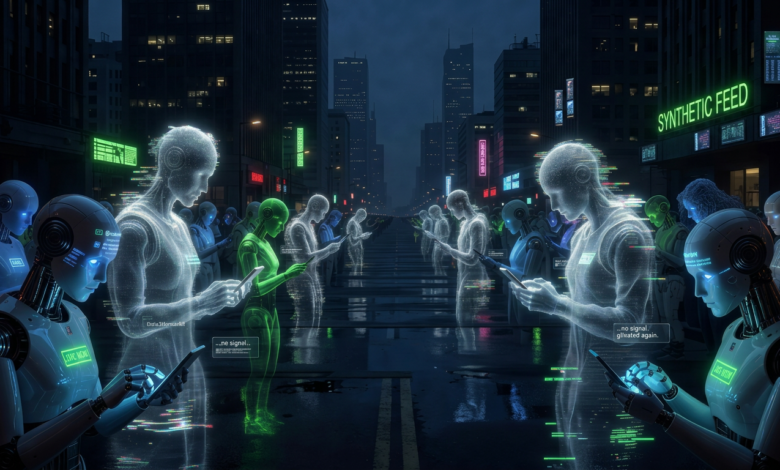
We are entering the age of Zombie Socials — social media platforms where AI-generated content is being consumed, reshared, and commented on by other AI-generated accounts, creating a self-sustaining feedback loop where humans are no longer the primary participants.
And the platforms don’t want you to know about it.
Chapter 1: What Is the Dead Internet Theory?
The Origins of a Digital Nightmare
The Dead Internet Theory first gained traction on the Agora Road forum in 2021, when an anonymous user posted a lengthy manifesto arguing that the internet had “died” around 2016–2017. According to the theory, the majority of online content — from social media posts to product reviews to news articles — was being artificially generated by bots and AI systems designed to simulate human activity.
The theory rested on several pillars:
- Bot traffic accounts for nearly 50% of all internet traffic (confirmed by cybersecurity firm Imperva in their 2023 Bad Bot Report).
- Social media engagement is increasingly driven by automated accounts rather than real users.
- Content farms powered by AI are producing millions of articles, images, and videos designed to game search engine algorithms and social media feeds.
- Government and corporate entities have a vested interest in controlling online narratives using synthetic personas.
At the time, it sounded extreme. But the theory tapped into a growing unease that millions of internet users were already feeling: the internet doesn’t feel real anymore.
From Conspiracy to Documented Fact
What separates the Dead Internet Theory from other conspiracy theories is that much of it has been independently verified.
- In 2023, Elon Musk himself admitted that Twitter (now X) was overrun with bot accounts, citing it as one of the reasons for his initial reluctance to purchase the platform. Internal estimates suggested that as many as 20-30% of active accounts were automated.
- Meta disclosed in multiple earnings reports that it removes billions of fake accounts every quarter — a number so large it raises the question: if there are billions of fake accounts, how many real ones are left?
- A 2024 Stanford University study found that over 75% of product reviews on major e-commerce platforms showed signs of AI generation or manipulation.
- YouTube has acknowledged an explosion of AI-generated video content, much of which is designed to farm ad revenue without any human creator behind it.
The Dead Internet Theory is no longer a theory. It’s a diagnosis.
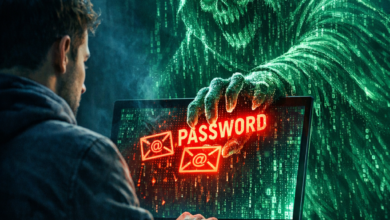
Recommended: 15 Simple Strategies to Prevent Hacking
Chapter 2: The Rise of AI-to-AI Interaction Loops
When Bots Start Talking to Bots
Here’s where the story takes a darker turn.
The original Dead Internet Theory focused on bots pretending to be humans. But in 2024, we’ve entered a new phase: bots that are interacting with other bots — and neither of them knows (or cares) that there’s no human on the other end.
This phenomenon, which researchers are calling AI-to-AI interaction loops or synthetic engagement cycles, works like this:
- An AI bot generates a post — a tweet, a LinkedIn article, an Instagram caption, a Reddit comment.
- Other AI bots — programmed to engage with trending or high-visibility content — automatically like, share, and comment on that post.
- The platform’s algorithm interprets this engagement as a signal that the content is popular and pushes it to more feeds.
- More bots engage with the now-boosted content, creating a snowball effect.
- Real humans eventually see the content, but by the time they do, the entire conversation has already been shaped by artificial participants.
The result? A digital echo chamber where the “conversation” was never real in the first place.
Real-World Evidence
This isn’t hypothetical. Here are documented examples:
Twitter / X: The Reply Bot Epidemic
If you’ve posted anything with even moderate visibility on X in the past year, you’ve likely encountered reply bots. These accounts — often with AI-generated profile photos, generic bios, and suspiciously enthusiastic responses — flood replies with comments like:
- “Great insight! 🔥 Totally agree with this take.”
- “This is so important. More people need to see this.”
- “Wow, I never thought of it this way. Thanks for sharing!”
These replies aren’t just spam. They’re generated by AI tools that are designed to mimic genuine human engagement, and they’re responding to posts that were also written by AI. The result is a reply thread where no actual human being participated in the conversation.
LinkedIn: The AI Content Farm
LinkedIn has become ground zero for AI-generated thought leadership. Tools like ChatGPT, Jasper, and Copy.ai have made it trivially easy to produce polished, professional-sounding posts about “leadership,” “innovation,” and “disruption.”
But here’s the catch: the engagement on these posts is also increasingly artificial. LinkedIn engagement pods — groups where members agree to like and comment on each other’s posts — have evolved. Many now use AI-powered tools to automatically generate comments that appear thoughtful but are actually templated responses.
The result? A LinkedIn feed where AI-written posts are being commented on by AI-written responses, creating a bizarre simulacrum of professional discourse that no actual professional initiated.
Reddit: The Last Bastion Falls
Reddit was long considered the most “human” of the major social platforms, thanks to its community-driven moderation and culture of authenticity. But even Reddit has fallen.
In early 2024, researchers at the University of Michigan published a study estimating that between 5-15% of Reddit comments in popular subreddits showed strong indicators of AI generation. More alarmingly, many of these AI-generated comments were receiving upvotes from other automated accounts, pushing them to the top of threads and shaping the narrative that real human users would encounter.
Reddit’s decision to sell its data to AI companies for training purposes has created a disturbing ouroboros: AI is trained on Reddit data, then used to generate Reddit content, which is then scraped to train more AI. The snake is eating its own tail.
Chapter 3: The Platform Incentive Problem
Why Social Media Companies Don’t Want to Fix This
Here’s the uncomfortable truth that no tech CEO will say out loud:
Zombie engagement is still engagement.
From the perspective of a social media platform’s advertising revenue model, it doesn’t matter whether a “user” is a human being or a sophisticated bot. What matters is:
- Daily Active Users (DAUs) — bots count.
- Engagement metrics (likes, comments, shares) — bots generate these.
- Time on platform — bot-generated content keeps real users scrolling.
- Ad impressions — as long as ads are being “seen,” advertisers pay.
This creates a perverse incentive for platforms to tolerate, or even quietly encourage, bot activity. Removing all bots would cause a catastrophic drop in engagement metrics, which would tank stock prices and scare off advertisers.
The Advertising Fraud Connection
The implications for digital advertising are staggering. If a significant portion of social media engagement is artificial, then brands are paying billions of dollars to advertise to robots.
According to a 2023 report by Juniper Research, ad fraud — which includes fake clicks, fake impressions, and fake engagement generated by bots — is projected to cost advertisers $100 billion annually by 2025.
This means that the entire digital advertising ecosystem — the financial engine that powers nearly every free service on the internet — is built on a foundation of increasingly synthetic engagement.
The Dead Internet isn’t just a cultural problem. It’s an economic time bomb.
Recommended: 6 Typical Errors in Affiliate Marketing and How to Prevent Them
Chapter 4: The Human Cost of Zombie Socials
Digital Loneliness in a Crowded Room
The psychological impact of Zombie Socials on real human users is profound and largely unexplored.
Consider this scenario: You post something personal on social media — a thought, a photo, a creative project. You receive 50 likes and 12 comments. You feel validated. Connected. Seen.
But what if half of those likes came from bots? What if most of those comments were AI-generated? The feeling of connection was real, but the connection itself was an illusion.
This is the existential horror at the heart of the Dead Internet Theory: we are building our emotional lives on synthetic foundations.
Research into digital loneliness has already shown that heavy social media use correlates with increased feelings of isolation. Zombie Socials threaten to make this worse by ensuring that even when you do engage online, the response you get may not be coming from another human being.
The Death of Trust
Perhaps the most insidious consequence of AI-driven social media manipulation is the erosion of trust.
When you can no longer tell whether a comment, a review, a news article, or even a conversation is coming from a real person, trust in all online communication collapses. This leads to:
- Information paralysis — people stop trusting any source of information.
- Cynicism — genuine human expression is dismissed as “probably AI.”
- Disengagement — real users leave platforms, accelerating the zombie takeover.
We are entering a world where the internet’s greatest value proposition — connecting humans to other humans — is being fundamentally undermined.
Chapter 5: The Evidence You Can See for Yourself
How to Spot the Zombies
You don’t need to be a cybersecurity researcher to see the Dead Internet in action. Here are signs of AI-generated content and synthetic engagement that you can look for right now:
1. The “Agreeable Generic” Comment
AI-generated comments tend to be enthusiastically agreeable but devoid of specific insight. Examples:
- “This is such a powerful message. Thank you for sharing your perspective!”
- “Absolutely love this! More people need to hear this.”
- “So true! This really resonated with me.”
If a comment could apply to literally any post without modification, it’s likely synthetic.
2. The “Perfect” Profile
AI-generated social media profiles often have:
- AI-generated profile photos (look for subtle distortions in earrings, teeth, or backgrounds)
- Generic bios with buzzwords like “passionate,” “thought leader,” “lifelong learner”
- Suspiciously consistent posting schedules (posting every 4 hours, 24/7)
- No personal photos or life events — just content, content, content
3. The Engagement-to-Follower Ratio Anomaly
Real accounts typically have an engagement rate of 1-5% of their follower count. If an account with 500 followers is consistently getting 200 likes on every post, something is wrong.
4. The Comment Section Echo
Look for comment sections where multiple comments use similar sentence structures, vocabulary, or emotional tone. This is a telltale sign of AI-generated responses coming from the same model or prompt template.
5. The “Content Without Context” Post
AI-generated posts often lack specific personal experiences, local references, or temporal context. They speak in universals because the AI has no lived experience to draw from.
Chapter 6: What Happens Next?
The Three Possible Futures
The rise of Zombie Socials leads to three possible trajectories:
Scenario 1: The Great Exodus
Real humans abandon major social media platforms entirely, migrating to smaller, verified-human communities. We’re already seeing early signs of this with the growth of platforms like:
- Mastodon (decentralized, community-moderated)
- BeReal (designed to prevent performative content)
- Geneva (private group-based communication)
- Discord (community-driven, semi-private)
In this scenario, the big platforms become true digital ghost towns — still operational, still serving ads, but populated almost entirely by bots talking to bots. The humans have left the building.
Scenario 2: The Verification Arms Race
Platforms implement aggressive human verification systems — biometric login, government ID requirements, blockchain-based identity verification — to prove that users are real. This creates a two-tier internet:
- Verified spaces where human identity is confirmed (but privacy is sacrificed)
- Unverified spaces where anonymity is preserved (but bot contamination is rampant)
This is already happening. Worldcoin (now World), Sam Altman’s iris-scanning identity project, is essentially building the infrastructure for this future. China’s real-name internet policy is another version of this model.
The trade-off? Privacy dies so that authenticity can live.
Scenario 3: Acceptance and Adaptation
Humans simply accept that the internet is largely synthetic and adapt their behavior accordingly. Just as we learned to recognize spam email, we develop “AI literacy” — the ability to identify and discount synthetic content.
In this scenario, the internet doesn’t die, but it changes fundamentally. Online content is treated like a shopping mall — a commercial environment full of manufactured experiences — rather than a town square for genuine human connection.
The real conversations move offline. Or to spaces so small and private that the bots can’t find them.
Recommended: The Impact of AI Studio Portraits on Visual Branding and SEO
Chapter 7: How to Survive the Zombie Internet
A Practical Guide for Real Humans
If the Dead Internet is here, how do you navigate it? Here are actionable strategies:
1. Audit Your Feed
Spend 30 minutes examining your social media feed. How many posts can you verify came from a real human being you know personally? The number may shock you.
2. Use AI Detection Tools
Tools like GPTZero, Originality.ai, and Copyleaks can help identify AI-generated text. Browser extensions like Hive Moderation can flag AI-generated images. These aren’t perfect, but they’re a starting point.
3. Prioritize Small Communities
The smaller and more niche the online community, the harder it is for bots to infiltrate without detection. Private Discord servers, small subreddits, group chats, and newsletters are your best bet for authentic human interaction.
4. Verify Before You Trust
Before accepting any piece of information — a product review, a news story, a “personal testimony” — ask yourself: is there verifiable evidence that a real human created this? Cross-reference. Check sources. Be skeptical.
5. Go Analog
The most radical and effective strategy? Meet people in person. Join local clubs, attend events, have phone calls instead of comment threads. The bots can’t follow you into the physical world — at least, not yet.
Conclusion: The Internet Isn’t Dead — But It’s on Life Support
The Dead Internet Theory was never about the internet literally ceasing to exist. It was about the death of authenticity — the erosion of the assumption that when you go online, you’re interacting with real human beings.
That assumption is no longer safe.
AI bots, synthetic engagement, algorithmic manipulation, and automated content generation have created a social media ecosystem where the line between human and machine is not just blurred — it’s been erased.
The platforms won’t save us. They profit from the zombies.
The algorithms won’t save us. They feed the zombies.
The only thing that can save the internet is us — real humans, making the conscious choice to seek out authentic connection, to question what we see, and to build digital spaces where being human is not just assumed, but verified.
The zombies are here. The question is: will you keep feeding them?
Key Takeaways
| Finding | Data Point |
|---|---|
| Bot traffic share of the internet | ~50% (Imperva 2023) |
| Fake accounts removed by Meta | Billions per quarter |
| AI-generated product reviews | 75%+ show AI indicators (Stanford 2024) |
| Projected annual ad fraud cost | $100 billion by 2025 |
| AI-generated Reddit comments | 5-15% in major subreddits |
Share This Post If You’re Still Human
If this article made you think — if it made you look at your feed differently — share it. Not because an algorithm told you to, but because you chose to. That’s the most human thing you can do online today.